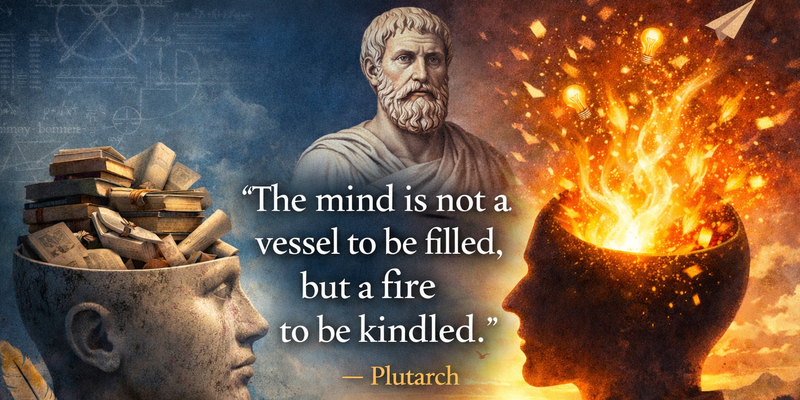
For centuries, education has often been imagined as a process of filling the mind with information. Students attend lectures, read textbooks, memorise facts, and reproduce them in examinations. But long before modern debates about learning methods began, the Greek philosopher Plutarch offered a powerful reminder that knowledge works very differently. His famous line—“The mind is not a vessel to be filled, but a fire to be kindled”—captures a deeper philosophy of learning that remains relevant even today.
At its core, the quote challenges the traditional view of education as a passive transfer of knowledge. If the mind were truly a vessel, then the role of teachers would simply be to pour information into it. Learning would become a mechanical activity, measured only by how much content a person can retain.
Plutarch’s metaphor replaces this image with something far more dynamic: a fire. A fire does not simply hold something—it grows, spreads, and generates energy. In the same way, the mind thrives not on accumulation but on curiosity, exploration, and inspiration. Education, therefore, is not about filling students with answers; it is about igniting their desire to ask questions.
Curiosity is the spark that starts the fire of learning. When people become genuinely interested in a topic, they naturally begin to explore it more deeply. They search for connections, challenge assumptions, and seek new perspectives.
Consider how children learn in their early years. They constantly ask “why”, not because they need to memorise facts but because they are trying to understand the world around them. This instinctive curiosity is the natural form of learning that Plutarch’s quote celebrates.
Unfortunately, many educational systems unintentionally suppress this spark. When success is measured mainly through exams and rote memorisation, students may focus more on storing information than understanding it. The result is often short-term knowledge that fades once the test is over.
Plutarch’s idea also redefines the role of educators. Instead of acting merely as providers of information, teachers become guides and catalysts. Their task is to create environments where curiosity can flourish.
This may involve encouraging debate, presenting real-world problems, or helping students discover knowledge for themselves. When learners feel engaged and intellectually stimulated, the learning process becomes far more meaningful and lasting.
Modern educational approaches increasingly recognise this principle. Project-based learning, critical thinking exercises, and interactive classrooms all aim to shift education away from memorisation and towards discovery.
In the digital age, Plutarch’s insight has become even more important. Information is now widely available online, meaning knowledge itself is no longer scarce. What truly matters is the ability to interpret, question, and apply that knowledge creatively.
In other words, education should not focus on how much information someone can store, but on how effectively they can think.
By viewing the mind as a fire rather than a vessel, Plutarch reminds us that learning is an active and lifelong process. When curiosity is nurtured, knowledge does not merely accumulate—it expands, evolves, and inspires further discovery.
And perhaps that is the most powerful lesson behind the quote: the goal of education is not simply to inform the mind, but to ignite it.